
Battling the Flood: heavy-Duty Storm Drainage Installation in Greenacres, FL
In Greenacres, Florida, managing stormwater is not a luxury—it is a necessity. With our flat terrain and intense tropical rainstorms, water has nowhere to go unless we create a path for it.
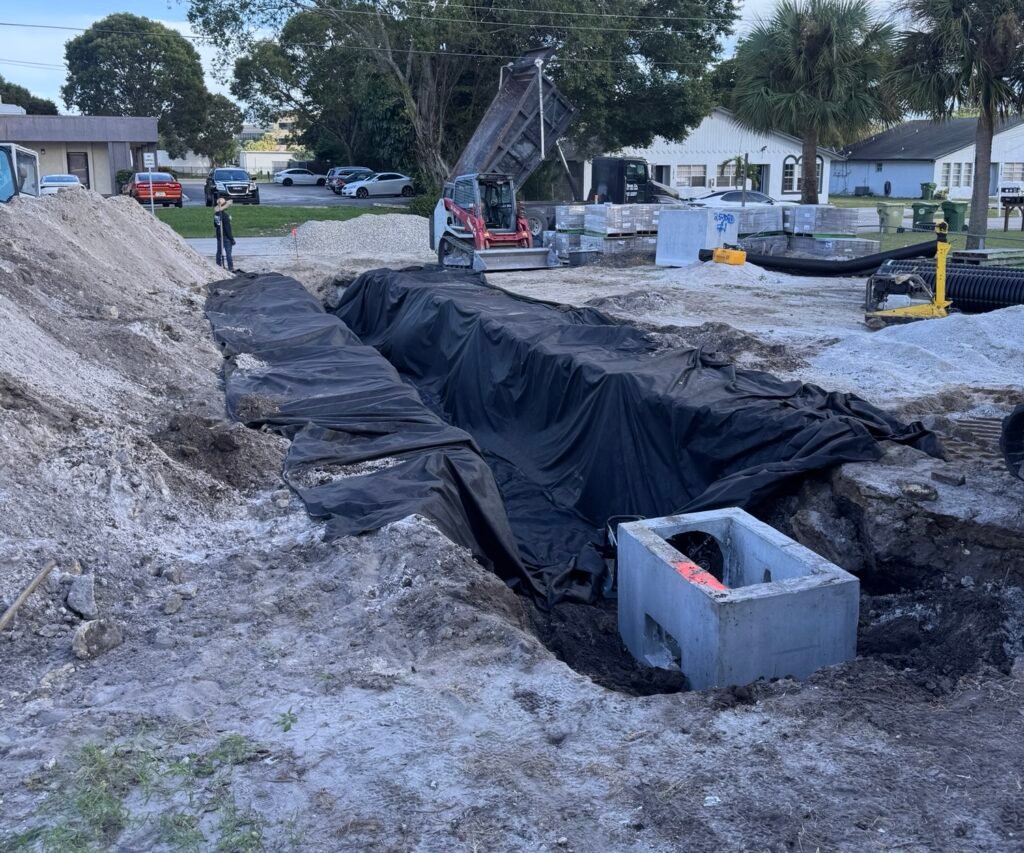
We recently completed a storm drainage installation project in Greenacres that highlights exactly what goes into keeping a property dry and safe. This was not a simple handyman repair. Instead, it was a complex infrastructure project involving heavy concrete drain basins, exfiltration trenches, and primary feeder lines.
Here is a look at the heavy lifting, special tools, and engineering precision required to install a system that will stand the test of time.
1. The Backbone: Setting Large Concrete Drain Basins
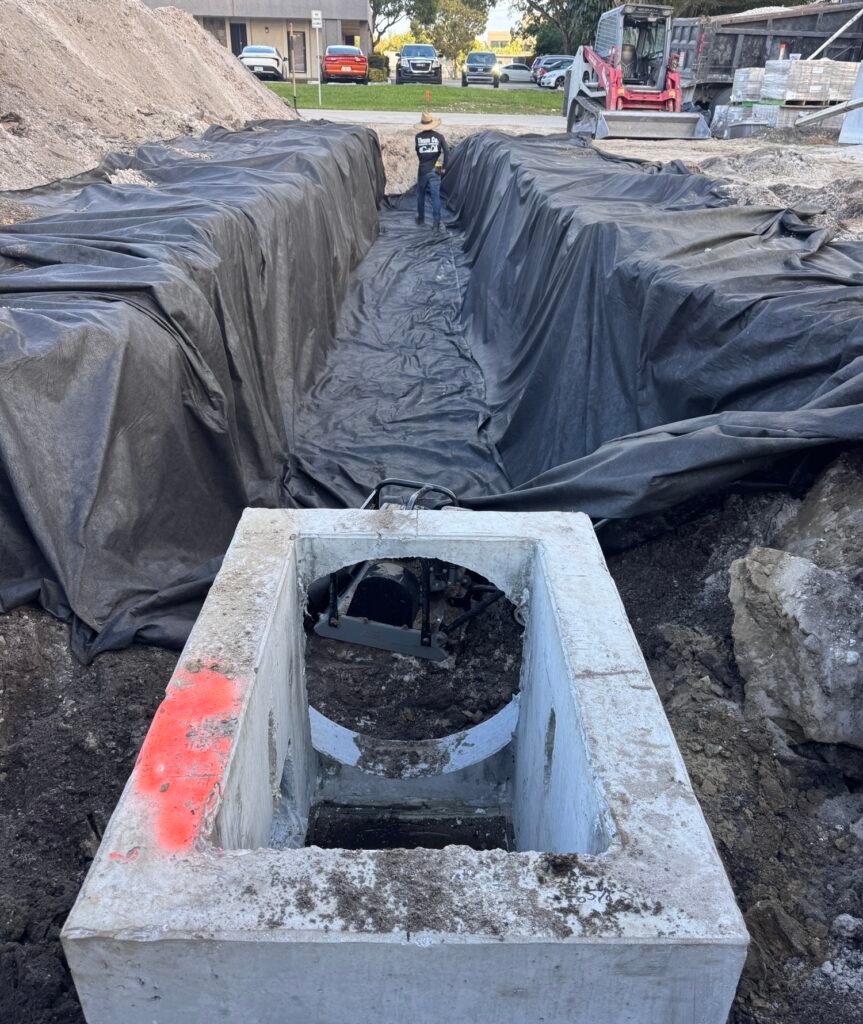
The most visible part of a storm system is the grate you see on the surface, but the real work happens underneath. For this project, we set large, heavy concrete drain basins (catch basins).
These structures weigh thousands of pounds and serve as the primary collection points for surface runoff. Installing them requires:
-
Heavy Machinery: We utilized large excavators and lifting equipment to maneuver these massive concrete structures safely into the pit.
-
Precision Leveling: The basin cannot just be “dropped in.” It must be set on a perfectly compacted base to prevent settling.
-
Elevation Accuracy: The rim must sit exactly flush with the eventual pavement or grade. If it is too high, water won’t enter; too low, and it creates a hazard.
2. The Science of the Exfiltration Trench
In Greenacres, we often use exfiltration trenches (often called “French drains” on a massive scale) to manage water volume. Rather than just piping water to a lake, an exfiltration trench allows the water to seep back into the surrounding soil, recharging the groundwater.
Installing this requires a deep understanding of Florida’s soil mechanics. We excavated the trench, lined it with geotextile fabric to prevent clogging, and filled it with clean aggregate rock. This acts as a temporary holding tank during heavy rains, allowing water to dissipate naturally rather than overwhelming the city streets.
3. Installing Primary Feeder Lines
Connecting the basins and the trench are the primary feeder lines. These large-diameter pipes are the arteries of the system.
This stage requires the most skill regarding “pitch” or “slope.” Because Florida is so flat, we often have very little room for error. We use laser levels and specialized grading tools for precision. This ensures the pipe has the exact downward slope required to keep water moving. If the pipe is off by even a fraction of an inch, debris will settle, causing blockages that are expensive to repair later.
4. Why Engineering Plans are Critical
You cannot “eyeball” a storm drainage system. On this Greenacres project, we followed the engineer’s plans down to the smallest fraction of an inch.
Civil engineers calculate the flow rates based on the square footage of the property and the expected rainfall. They specify the exact pipe size, the invert elevations (the bottom height of the pipe), and the basin capacity.
-
Compliance: We ensure strictly that the installation matches the approved blueprints.
-
Longevity: By adhering to the plans, we ensure the system handles the hydraulic load it was designed for, preventing backups during the hurricane season.
5. The Need for Specialized Tools and Skilled Crews
This level of infrastructure work requires a high barrier to entry. It takes a crew that understands not just how to operate heavy equipment, but how to interpret complex civil engineering drawings.
From the compaction equipment used to stabilize the earth around the structures, to the lasers used for pipe alignment, the right tools are essential. But the tools are useless without the knowledge of how to use them in the unique sandy and wet soil conditions of Palm Beach County.
Summary
A storm drainage system is an investment in the safety and longevity of a property. When installed correctly—with heavy concrete basins, properly engaged exfiltration trenches, and laser-aligned feeder lines—it becomes an invisible shield against flooding.