Helical Piling Installation in Palm Beach County, Florida
Professional helical piling installation for deep foundation support throughout Palm Beach County and surrounding South Florida areas. Thum Co. Contractors installs helical pile systems to load-bearing strata, providing foundation support for structures requiring deep foundations due to unsuitable surface soils, high loads, or specific engineering requirements.
Our helical piling team serves West Palm Beach, Lake Worth, Boynton Beach, and surrounding areas. We work from structural engineering plans to install helical piling systems that transfer building loads through weak surface soils to stable bearing strata below.
Call (561) 366-2050 for a free helical piling installation estimate in Palm Beach County.
What Are Helical Pilings?
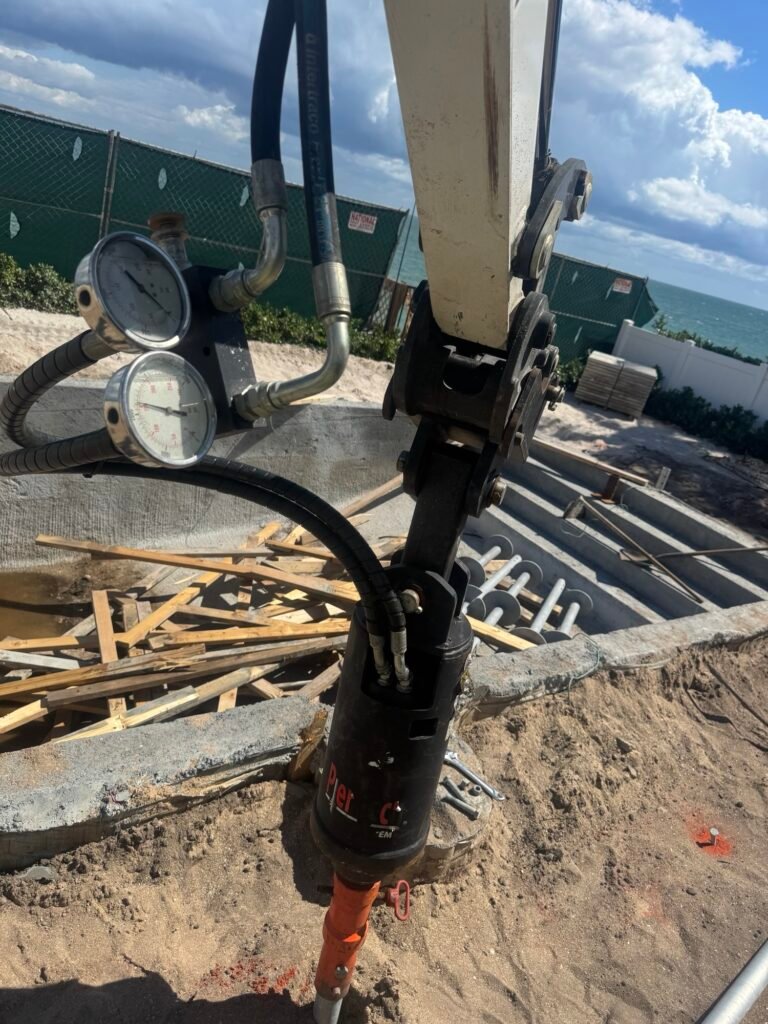
Helical pilings (also called helical piles, screw piles, or helical anchors) are steel foundation support members with helical bearing plates welded to a central steel shaft. The helical plates act like screws, allowing the pile to be rotated into the ground to bearing depth, providing load-bearing capacity where surface soils won’t support conventional foundations.
Helical piling systems work by:
- Transferring building loads through unsuitable surface soils
- Bearing on stable strata at depth (limestone, dense sand, or competent soil)
- Providing tensile resistance (uplift capacity) when needed
- Creating deep foundation support without large equipment or access requirements
These systems are common throughout Palm Beach County where surface soils often lack adequate bearing capacity for conventional foundations.
When Helical Pilings Are Needed
Unsuitable Surface Soils
Properties with organic soils (muck), loose sand, high-plasticity clays, or other materials that compress under load require deep foundations. Helical pilings bypass these unsuitable soils reaching competent bearing strata below.
This is common throughout low-lying areas of Palm Beach County where organic soils extend several feet below grade.
High Water Table Conditions
Areas with high water tables may have saturated soils providing insufficient bearing capacity. Helical pilings reach below the water table to stable bearing strata throughout South Florida.
Heavy Building Loads
Large homes, commercial buildings, or structures with concentrated loads may exceed surface soil capacity even when soils are generally adequate. Engineers specify helical pilings to provide additional support.
Additions and Renovations
Adding to existing structures sometimes requires deep foundations matching or exceeding the capacity of original foundations. Helical pilings provide this support without extensive excavation.
Coastal and Waterfront Properties
Properties near water often have particularly poor surface soils requiring deep foundation support. Helical pilings work well for these challenging conditions throughout Palm Beach County.
Seawall and Dock Support
Marine structures like seawalls, docks, and boat lifts use helical piling foundations resisting both vertical loads and lateral forces from water and boats.
How Helical Pilings Work
Helical Bearing Plates
Steel helical plates (spiral blades) are welded to a central steel shaft at specific spacing. Common configurations include:
- Single helix for lighter loads
- Double helix for moderate loads
- Triple helix for heavier loads
Helix diameter typically ranges from 8 to 14 inches, with larger diameters providing greater bearing capacity.
Installation and Load Transfer
During installation, helical pilings screw into the ground with the helical plates cutting through soil like a screw threading into wood. The helical plates bear against undisturbed soil at depth, transferring building loads to competent bearing strata.
Unlike driven piles that compact soil, helical pilings minimize soil disturbance, making them ideal for sensitive sites throughout Palm Beach County.
Torque-to-Capacity Correlation
A unique advantage of helical pilings is that installation torque directly correlates to pile capacity. Engineers can verify adequate capacity during installation by measuring the torque required to advance the pile—higher installation torque indicates higher bearing capacity.
This provides real-time quality control not available with many other foundation systems throughout South Florida.
Helical Piling Installation Process
1. Engineering and Design
Structural engineers design helical piling systems based on soil testing (borings or SPT tests), building loads, and site conditions. Engineering specifies helix configuration, shaft diameter, required capacity, and installation depth throughout Palm Beach County.
2. Site Preparation
We verify pile locations per foundation plans, ensure equipment access to all pile positions, and coordinate with excavation work if needed for access or grade preparation.
3. Pile Installation
Using specialized high-torque hydraulic drive equipment, we screw helical pilings into the ground to specified depths or torque values. The helical plates pull the shaft down as it rotates, advancing the pile to bearing depth.
Installation continues until piles achieve required installation torque (correlating to design capacity) or reach specified depth on competent bearing strata.
4. Torque Monitoring and Capacity Verification
Throughout installation, we monitor torque values ensuring piles meet or exceed design requirements. This real-time verification confirms each pile has adequate capacity before proceeding.
If torque values are insufficient, piles can be extended with additional shaft sections to reach deeper bearing strata.
5. Pile Cut-Off and Preparation
After installation, we cut piles to proper elevation, prepare pile tops for connection to foundations, and install pile caps or connection hardware per engineering specifications.
6. Foundation Connection
Foundation construction connects to pile tops through pile caps, grade beams, or direct connections, transferring building loads to the helical piling system.
Advantages of Helical Piling Systems
Smaller Equipment: Helical piling installation equipment is more compact than large pile driving rigs, allowing access to tight residential sites throughout Palm Beach County.
Low Vibration and Noise: Installation creates minimal vibration compared to impact-driven piles, reducing concerns about nearby structures and eliminating noise complaints in residential areas.
Immediate Loading: Unlike some foundation systems requiring curing time, helical pilings can be loaded immediately after installation throughout South Florida.
Real-Time Capacity Verification: Torque monitoring during installation verifies capacity in real-time, providing quality assurance for every pile.
Versatile Applications: Helical pilings work for new construction, additions, underpinning, marine structures, and various applications throughout Palm Beach County.
All Weather Installation: Installation can proceed in most weather conditions unlike some foundation methods sensitive to rain or ground saturation.
Clean Installation: Minimal soil spoils and disturbance compared to drilled or driven pile systems.
Removable and Reusable: In temporary applications, helical pilings can be unscrewed and removed, even reused in some cases.
Pile Capacity and Engineering
Engineers determine required pile capacity based on:
- Building dead loads (permanent weight)
- Live loads (occupancy and use)
- Environmental loads (wind, flood)
- Soil conditions and bearing strata depth
- Factor of safety (typically 2.0 or greater)
Typical residential applications may require 15-40 helical piles depending on building size and loads. Commercial applications vary widely based on structure size and loads.
Individual helical pile capacity typically ranges from 15-100+ kips (7.5-50+ tons) depending on helix configuration, soil conditions, and installation depth.
We install helical piling systems exactly per engineering specifications throughout Palm Beach County.
Helical Piling Components
Central Shaft: Round or square steel shaft (typically 2⅞ to 3½ inches diameter or 1.5-2 inch square) providing structural strength and torsional capacity during installation.
Helical Bearing Plates: One or more steel helical plates welded to the shaft. Plates are true helixes (not just angled disks) that cut through soil during installation.
Extension Shafts: Additional shaft sections can be coupled to the lead section if deeper installation is needed to reach bearing strata or achieve required torque.
Pile Caps/Brackets: Connection hardware at pile tops for attaching to foundations, grade beams, or structural elements.
Corrosion Protection: Hot-dip galvanizing or epoxy coatings provide corrosion resistance in aggressive South Florida soils.
Soil Conditions in Palm Beach County
South Florida presents challenging foundation conditions:
Organic Soils (Muck): Highly compressible organic material common in low areas, completely unsuitable for foundations. Helical pilings pass through muck to competent bearing strata below.
Loose Sand: Saturated loose sands provide minimal bearing capacity. Helical bearing plates engage denser sand layers at depth.
Limestone: Underlying limestone provides excellent end bearing when reached by helical pilings, though depth varies (typically 8-25 feet in Palm Beach County).
High Water Table: Groundwater often within 2-5 feet of surface affects soil strength and foundation design. Helical pilings work effectively in saturated conditions.
Helical pilings address these conditions effectively throughout South Florida by reaching competent bearing strata regardless of surface soil quality.
Coordination with Foundation Work
Helical piling installation coordinates with foundation construction:
Timing: Helical pilings install before foundation formwork and reinforcement.
Grade Beams: Foundations using grade beams spanning between pile caps require coordinated installation.
Pile Caps: Concentrated pile groups may need pile caps distributing loads to multiple helical pilings.
Connection Details: Engineering specifies how foundations connect to pile tops—embedment, welding, or mechanical connections.
We coordinate all aspects ensuring proper foundation-to-piling connection throughout Palm Beach County.
Load Testing and Quality Control
Quality control for helical piling systems:
Torque Monitoring: Every pile installation includes torque monitoring correlating installation torque to design capacity. This provides real-time verification of pile performance.
Proof Load Tests: Some projects require testing selected piles to verify they meet or exceed design capacity through actual load application.
Installation Records: We document torque values, depths, and installation parameters for every pile providing complete quality documentation.
Inspection: Building departments or third-party inspectors may verify installation and review documentation.
We provide all required testing and documentation for projects throughout South Florida.
Marine and Waterfront Applications
Helical pilings work exceptionally well for waterfront structures:
Seawalls: Providing structural support resisting lateral earth and water pressure.
Docks and Piers: Supporting dock structures and resisting vertical and lateral loads.
Boat Lifts: Anchoring boat lift systems to stable foundations.
Shoreline Structures: Supporting various waterfront improvements throughout Palm Beach County coastal areas.
Tension Applications: Helical pilings excel at resisting uplift forces—the helical plates provide exceptional pullout resistance for tie-backs, anchors, and tension applications.
Marine applications typically use hot-dip galvanized or epoxy-coated piles for corrosion resistance in salt water environments.
Frequently Asked Questions
How much does helical piling installation cost? Helical piling costs vary based on required capacity, installation depth, number of piles, and site access. Residential foundation piling typically ranges $150-$300 per pile installed. Total foundation cost depends on how many piles engineering requires. Contact us at (561) 366-2050 for a quote based on your engineering plans.
How deep are helical pilings installed? Depth varies based on bearing stratum location and required capacity. Typical depths in Palm Beach County range 10-30 feet, though some sites require deeper or shallower installation based on soil conditions and torque requirements.
Do I need a structural engineer? Yes, helical piling systems require structural engineering design. Engineers perform soil testing, calculate required capacity, specify helix configuration and depth, and design foundation connections.
How long does helical piling installation take? Installation rate varies with site conditions but typically ranges 15-30 piles per day. Most residential projects (20-40 piles) complete in 1-2 days. Larger commercial applications take longer based on pile quantity.
What is the advantage of helical pilings over other deep foundations? Key advantages include smaller equipment for tight access, minimal vibration and noise, immediate load capacity, real-time torque verification, and clean installation with minimal soil disturbance throughout Palm Beach County.
Can helical pilings be installed in tight access areas? Yes, compact installation equipment accesses tight residential locations where large pile driving rigs can’t reach. This is a major advantage for additions, renovations, and infill construction throughout South Florida.
What happens if a pile doesn’t achieve required torque? If a pile reaches design depth without achieving required torque, we extend the pile with additional shaft sections, advancing deeper until proper torque values are reached at competent bearing strata.
Do helical pilings work in high water table conditions? Yes, helical pilings work effectively in saturated soils and high water table conditions common throughout Palm Beach County. They’re specifically designed for these challenging conditions and the helical plates engage bearing soils effectively even when saturated.
Related Services
Helical piling installation often involves additional work:
- Foundation Construction – Concrete foundations
- Excavation & Site Work – Site preparation
- Building Pad Construction – Pad preparation
Get Your Helical Piling Installation Estimate
Ready for helical piling installation in Palm Beach County? Contact Thum Co. Contractors for professional deep foundation helical piling from your engineered plans.
Call (561) 366-2050 for helical piling installation.
Thum Co. Contractors 468 Tall Pines Rd. West Palm Beach, FL 33415
Licensed building contractors providing helical piling installation throughout Palm Beach County and surrounding South Florida areas since 2017.