Professional storm drain installation for a high-end home on the intracoastal in Tequesta, Florida. Thum Co. Contractors installed a 24-inch Nyloplast drain basin and exfiltration trench built exactly to the civil engineer’s drawings — engineered drainage designed to handle South Florida storm events on a waterfront lot.
Our storm drain team managed the full installation across the property, from excavation along the seawall to setting the basin, laying perforated pipe on gravel bedding wrapped in filter fabric, and grading everything to drain as designed. Waterfront work in Tequesta leaves no room for shortcuts, and this system was built to perform for decades.
Call (561) 366-2050 for a free storm drain estimate in Tequesta and throughout Palm Beach County.
Project Overview
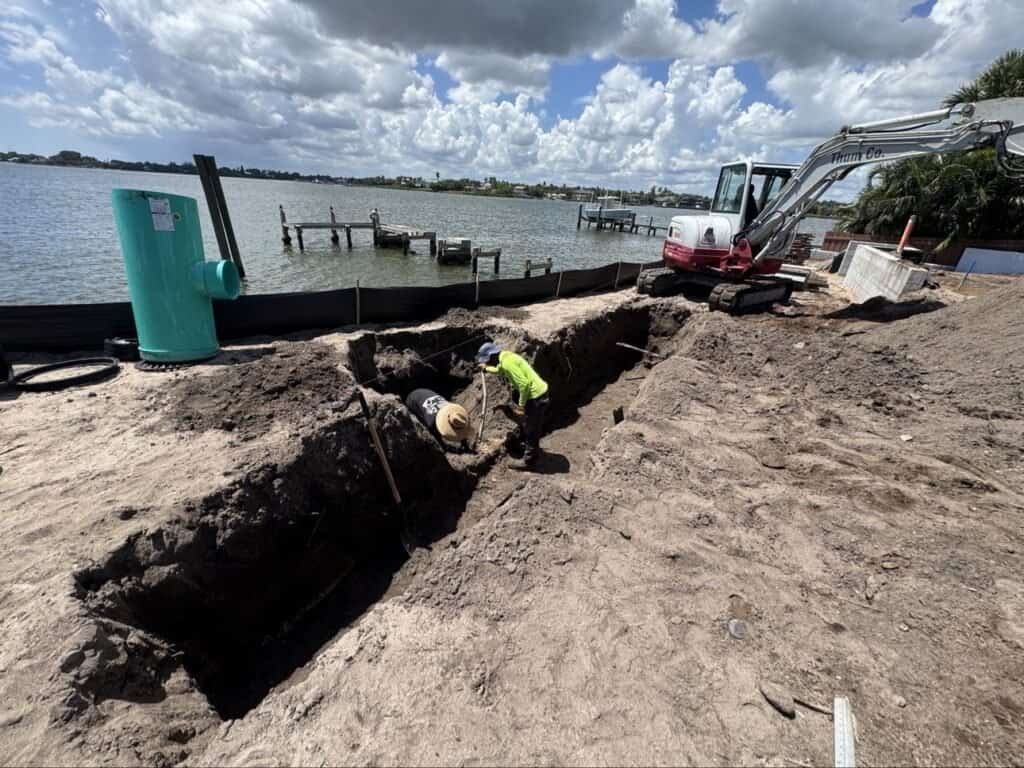
Engineered from the start. This wasn’t a guess-and-grade job. The drainage plan came from the project’s civil engineer, and our crew built it to spec — trench depths, pipe slopes, gravel bedding, and basin placement all verified against the drawings as work progressed.
Built for the waterfront. The property sits directly on the intracoastal, where stormwater management has to account for high water tables, tidal influence, and heavy seasonal rain. The exfiltration trench gives runoff a designed path into the ground instead of ponding against the home or running uncontrolled toward the seawall.
24-Inch Nyloplast Drain Basin Installation
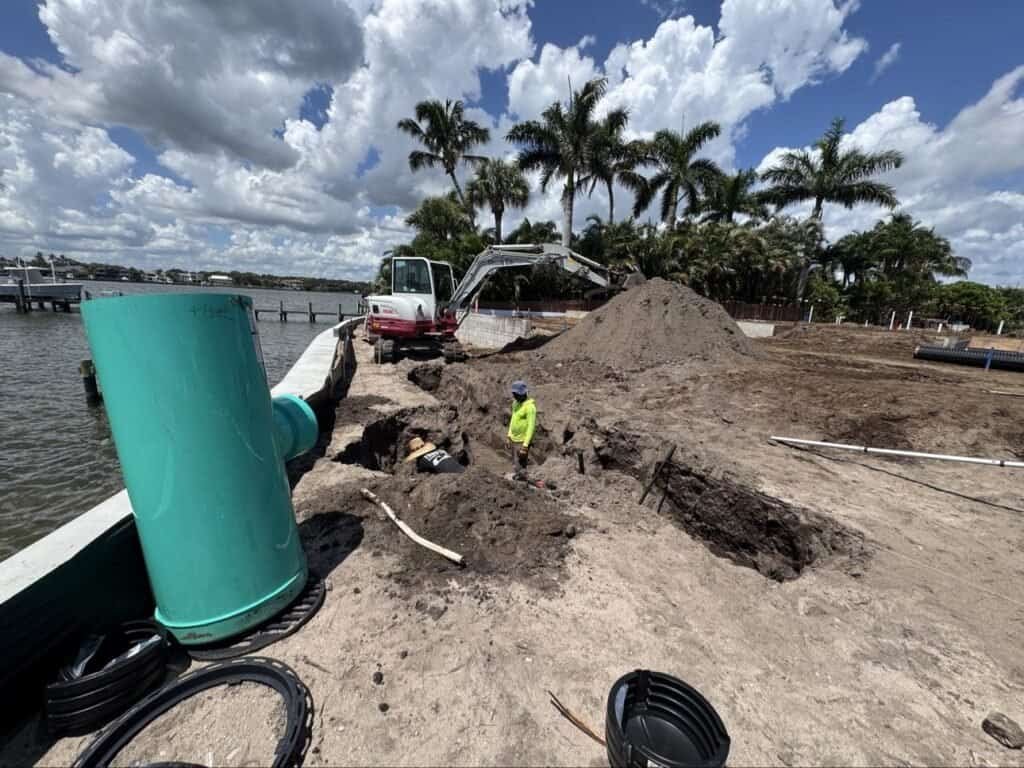
The centerpiece of the system is a 24-inch Nyloplast drain basin — a heavy-duty polymer structure specified by the engineer for its strength and corrosion resistance in a salt-adjacent environment. Unlike concrete structures that can crack and degrade, the Nyloplast basin arrives as a single engineered unit, gets set to grade, and connects directly to the perforated collection pipe.
Our crew excavated for the basin, set it level on a prepared base, and tied it into the exfiltration trench so surface water collected at the grate moves straight into the underground system.
Exfiltration Trench Construction
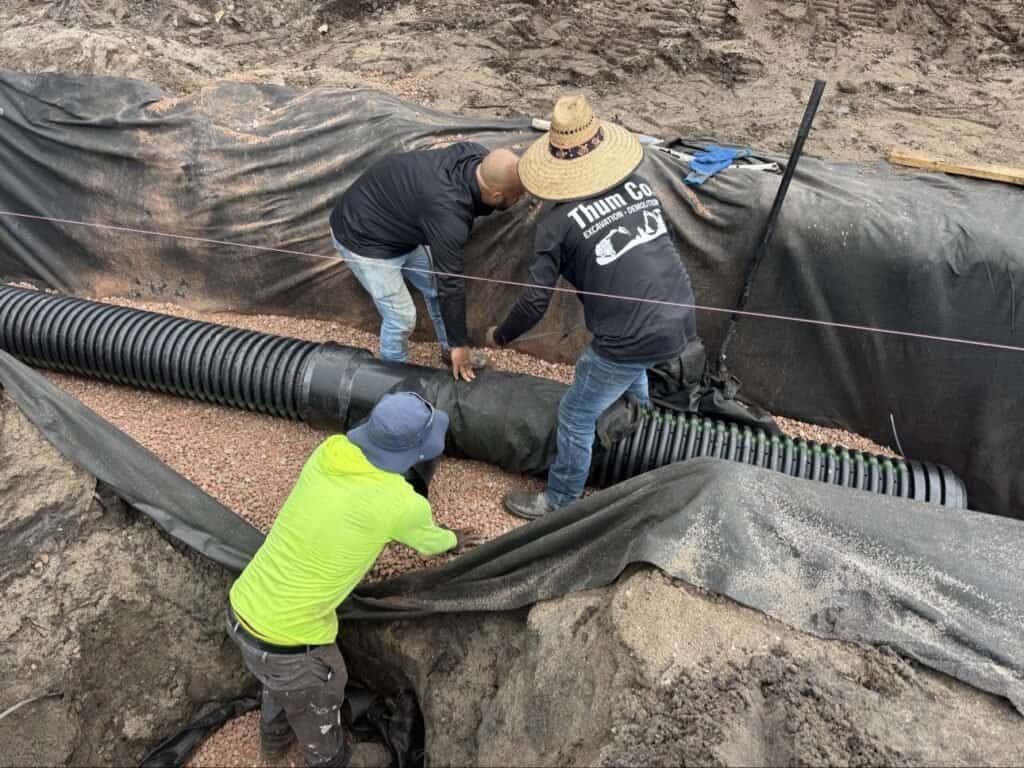
The exfiltration trench is the workhorse of this system. Our team excavated the trench to the engineered depth and profile, then built it up in layers: filter fabric lining the excavation, washed gravel bedding, perforated HDPE pipe set to the designed slope, more gravel, and fabric wrapped over the top to keep fine soils out of the stone reservoir.
Why the layers matter. The filter fabric keeps the sandy South Florida soils from migrating into the gravel and clogging the system. The gravel creates void space that stores stormwater during a downpour. The perforations let that stored water exfiltrate — soak — into the surrounding ground over time. Done right, the trench handles volume and drainage at the same time.
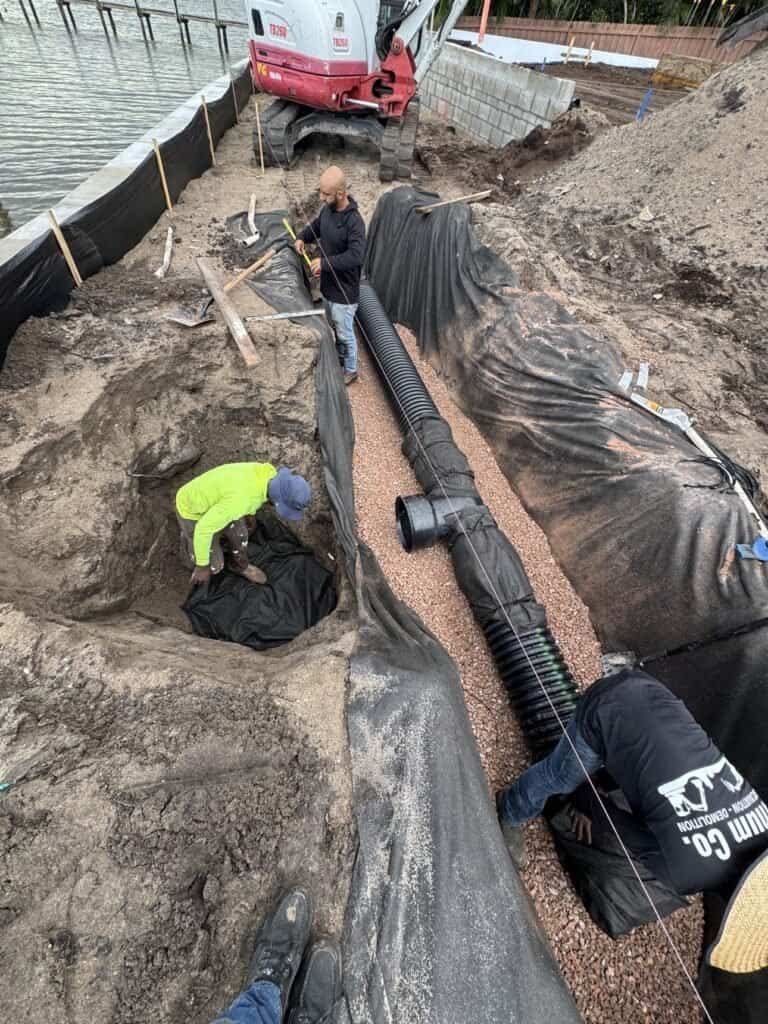
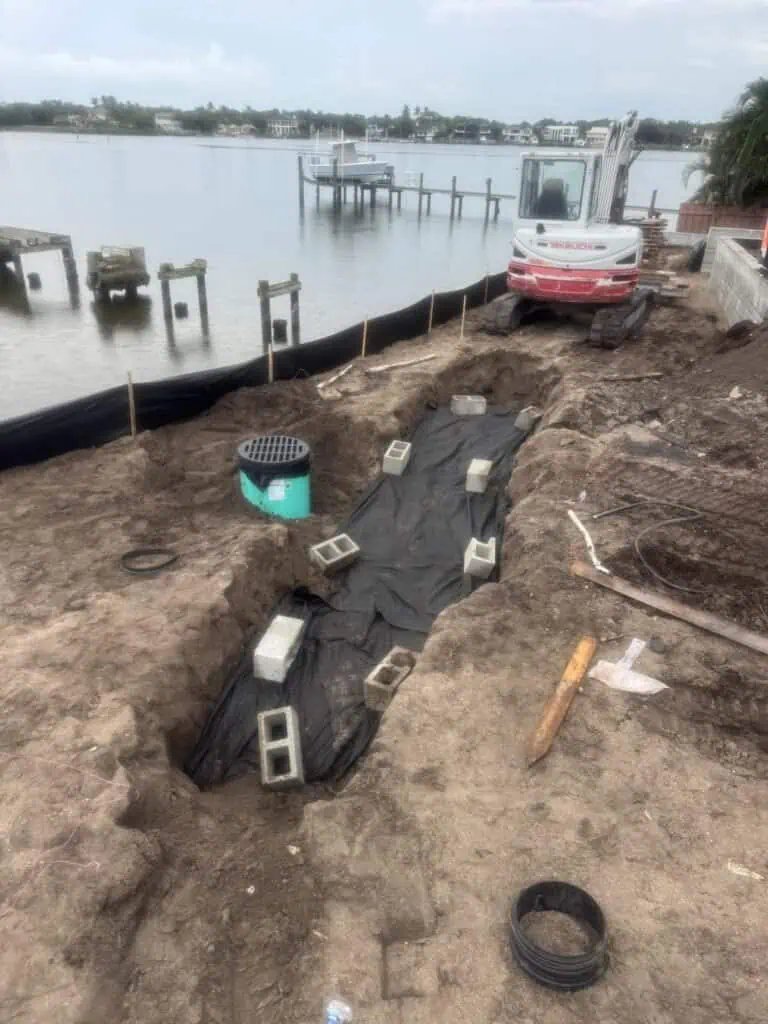
With the basin set and the trench built, the crew backfilled and graded the area to direct surface water toward the collection points, leaving the site clean and ready for the next phase of construction.
Our Storm Drain Installation Process
- Review the engineered drawings. We build to the civil engineer’s plan — depths, slopes, materials, and locations verified before we dig.
- Excavate to spec. Trench and basin excavations are cut to the designed dimensions, with care taken around the seawall and existing site features.
- Prepare the bedding. Filter fabric goes in first, followed by washed gravel bedding compacted to grade.
- Set structures and pipe. The Nyloplast basin is set level; perforated pipe is laid to the designed slope with fittings connected and sealed.
- Wrap, backfill, and grade. Fabric wraps the gravel reservoir, trenches are backfilled in lifts, and the surface is graded to feed the system.
- Verify and clean up. We check slopes and connections against the drawings, then leave the site clean.
Why Waterfront Homes in Tequesta Need Engineered Storm Drainage
Tequesta’s waterfront properties face a combination most inland lots never see: high water tables, tidal influence on groundwater, intense summer storms, and strict local requirements for managing runoff before it reaches the intracoastal. A standard swale-and-hope approach doesn’t cut it on these lots.
Designed systems protect the investment. On a high-end home, poor drainage shows up as ponding, foundation moisture, landscape washouts, and runoff problems at the seawall. An engineered system — basin, trench, and grading working together — moves water the way the site was designed to handle it.
We build what the engineer drew. As state-licensed building contractors, we work from civil engineering plans regularly, coordinate with the project team, and install exactly what was specified. That matters for inspections, for performance, and for the homeowner’s peace of mind.
FREQUENTLY ASKED QUESTIONS ABOUT STORM DRAIN INSTALLATION IN TEQUESTA, FL
An exfiltration trench is an underground stormwater system built from perforated pipe buried in a gravel reservoir wrapped in filter fabric. During a storm, runoff flows into the trench and is temporarily stored in the voids between the gravel, then slowly exfiltrates — soaks — into the surrounding soil. It’s one of the most effective ways to manage stormwater on lots where surface space for retention is limited, which is common on Tequesta waterfront properties.
The project’s civil engineer specified a 24-inch Nyloplast drain basin for its structural strength, corrosion resistance, and watertight connections. Nyloplast basins are made from heavy-duty polymer rather than concrete, so they won’t crack, spall, or degrade in South Florida’s wet, salt-adjacent conditions. The 24-inch diameter provides the collection capacity the drainage calculations called for at this location.
For most new construction and significant site work in Tequesta, yes — the city typically requires engineered drainage plans as part of the permit package. Even where not strictly required, an engineered design is worth it on waterfront lots, where high water tables and runoff rules make guesswork risky. We install to engineered drawings regularly and can coordinate with your engineer or builder.
It has to be designed for it. Near the intracoastal, the water table can sit just a few feet below grade, which limits how deep a system can exfiltrate. Engineers account for this with seasonal high water table elevations, and the system — trench depth, stone reservoir size, and outlet elevations — is sized accordingly. This is exactly why waterfront drainage should be engineered rather than improvised.
In most cases, yes. Storm drainage work in Tequesta typically requires a permit, and new construction drainage is reviewed as part of the overall building permit with engineered plans. As licensed building contractors, we handle permit applications and build to the approved plans so the work passes inspection.
A project of this scope — basin, exfiltration trench, grading — typically takes several days of fieldwork once mobilized, depending on trench length, site access, and weather. Engineered waterfront work moves deliberately: every depth and slope gets verified against the drawings. Call (561) 366-2050 and we can give you a realistic timeline for your specific site.
Less than you’d think. Keep the basin grate clear of leaves and debris so water can enter the system, and have the system inspected if you notice ponding that wasn’t there before. The filter fabric and gravel are designed to keep the system functioning for decades with minimal intervention — which is why correct installation matters so much.
It depends on the engineered design: trench length and depth, basin sizes, site access, dewatering needs, and whether the work is part of new construction or a retrofit. To give you a sense of the numbers: a single 24-inch Nyloplast basin alone runs around $5,000 just for the structure — before excavation, pipe, gravel, and installation labor. These are expensive, engineered systems, not commodity parts. Waterfront lots with high water tables can require even more extensive systems. The honest answer is that every site is different — call (561) 366-2050 for a free estimate based on your property and plans.
Related Services
- Storm Drain Installation in Palm Beach County
- Exfiltration Trench Installation
- Catch Basin Installation & Repair
Get Your Storm Drain Estimate
If you’re building on the water in Tequesta — or anywhere in northern Palm Beach County — and need storm drainage done right, talk to the contractor who installs to the engineer’s drawings and stands behind the work.
Call (561) 366-2050 for storm drain services in Tequesta and throughout Palm Beach County.
Thum Co. Contractors, 468 Tall Pines Rd., West Palm Beach, FL 33415